

Equipment World
John Deere Unveils E Series CTL Machines
On May 26-29 John Deere held an international press event around the revealing ceremony for its new E series of wheel-type cut-to-length machines in Sweden and Finland. Forty forest industry journalists from 13 countries attended. Timo Salomaa, Deere Forestry Communications Manager for Europe and Russia, and Dieter Reinish, Communications Specialist for John Deere Forestry AB in Sweden, led the festivities.
On the first day the group toured Deere’s Swedish retail office/parts warehouse in Marsta, just outside Stockholm, where Reinish gave an overview of Swedish forestry. Later that day, journalists watched a demonstration of Deere’s 1490D slash bundler, which gathers and prepares logging slash for bioenergy use. On Tuesday the group attended a World Bioenergy Conference in Jonkoping, taking in a variety of machines and information pertaining to the rapidly emerging biomass sector.
Feature
Bioenergy Up Close by Peter Barynin and Keun-Hac Lee
The best way, or most profitable way, to sell a shovel is to find a thirsty man in the desert. Timber harvesters, hit hard by the housing slump and the run-up in diesel costs, have been offered the promise of new revenue streams in the bioenergy market. But in order to realize this promise it seems they must buy the “shovel” and do the heavy digging before it can become a reality. They are justifiably reluctant to jump headlong into this promised oasis. Although new demand from bioenergy does exist, and more is on the way, the timing and location of these demand sources are spotty at present.
Attitudes toward the emerging biomass industry are wildly different. Some loggers see an emerging biomass industry as a chance to attract new customers, create a market for harvesting residuals and new markets for pulpwood-grade timber and justify more aggressive forestland management. This group is aggressively forging relationships with prospective new stakeholders, hiring and trainin

Clearing the Way
In this economy, one might think that any company with “tree” in its name would be anchored in the woods, and perhaps struggling to survive. Employee-owned Lewis Tree Service, Inc. (LTS), is an exception.
LTS provides vegetation management services to utilities and governments, primarily in the eastern U.S. “We’ve tripled in size in the seven years that I’ve been with the company, and we are continuing to grow at a pretty good rate,” says Mike Moser, director of fleet and purchasing. The company is not totally immune to the downturn in the economy; although the impact thus far has not been significant. “In the last few months we have seen utilities reducing their vegetation maintenance some, but I don’t expect that to continue long-term,” Moser says.

From Flames to Fortune by Ken Bones
Life was pleasant for George Vernon in the mid-60s. Then his dairy barn burned. While the flames may not have been directly responsible for what was to come, the fire was a pivotal point in Vernon’s life.
Needing income, Vernon and his brother, Wayne, hired out to work on a crew erecting electrical transmission line towers. Frustration followed the brothers, for the erection crew was often held up waiting for the clearing contractor to prepare the right-of-way. The Vernons knew they could do better. So they launched a company called Northern Clearing, Inc. (NCI) and began preparing transmission tower rights-of-way themselves.
Fuel Poll: YES!
Olympia, Wash.: Yes. Get out of the way of exploration, production and refining. Get out of the way of implementation of new technologies. Stop all social spending programs and divide savings—half to debt reduction, half to new energy technology research. Short-term benefits: lowering of current energy prices. Long-term benefits: debt reduction and a more productive, efficient economy. We could lower costs over time with new technology.
Peapack, NJ: Yes. The government might want to persuade OPEC that it is in its best interests to keep the price of a barrel of oil to a more manageable dollar amount because it will eventually bite OPEC in the butt.

Good Numbers by Tonya Cooner-Vots
Loggers and associated manufacturers turned out in surprisingly good numbers for the 25th iteration of the Mid-South Forestry Equipment Show, held June 6-7 just south of town in the intensely-managed Mississippi State University (MSU) John W. Starr Memorial Forest. According to show officials, an estimated 6,000 people of all stripes passed through the gate.
“Despite the industry’s problems and a slow economy, attendees and exhibitors stepped up,” says Show Manager Charles Burkhardt. “We were very pleased with the participation, and I think exhibitors and attendees were satisfied with their Mid-South Show experience this year.”

Update: Chippers/Grinders
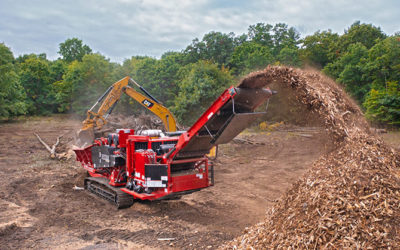
Anticipating an increase in demand for woody biomass, two years ago Bandit began developing new products to expand its line of fuel wood harvesting machines.
The model 3090, a 24 in. diameter capacity unit with a large 34x30 in. opening, has a larger drum, larger chipper opening and a more powerful feed system that includes a drag chain infeed conveyor. With a 630 HP engine, this chipper can fill a 45 ft. trailer in less than 20 minutes.
Mixed Stand
GL Forwarder Operator Challenge
Great Lakes Timber Professionals Assn. and Komatsu Forest, LLC are promoting the national 2008 Great Lakes Forwarder Operator Challenge at the Lake States Logging Congress, September 4-6 at Green Bay, Wis.
Open to all experienced forwarder operators, the fun event showcases operator skills, emphasizes machine advances and recognizes standout operators.
Mooney's Corner
On The Horizon... A Logger Union? by Jim Mooney
Fast forward to a not-so-distant point in the future… It’s only been two years since the merger of the last remaining major U.S. forest products companies, IP, G-P, and LP, into the super company P3. Out of the turmoil, loggers located along or near the Atlantic coast of the Southeast—roughly a 100-mile band stretching from eastern North Carolina to northeastern Florida—have pulled off the unthinkable. They successfully formed the first logger union and forged a collective bargaining agreement with P3 to log its many mills located in parts of four states. A majority of loggers in this stretch has joined United American Loggers (UAL) and hired, somewhat reluctantly, the iron-fisted Vinni Giacomo as president. Giacomo is well known for his previous work with the New Jersey Sanitation Workers Union.
Product Showcase
New Products & Technologies
Tigercat’s extreme duty forwarder line has been redesigned with the operator in mind. The first B-series model to hit the market is the 1075B, a 22 ton capacity machine; 11 and 14-ton class machines (1045B and 1055B) will follow.
Most B-series changes have taken place in the cab and operators will immediately notice increased comfort levels and reduced fatigue over long shifts. The cabin interior finish has been significantly upgraded with improved ergonomics and an automotive style finish. The joystick pods are easier to operate, having only one function per control.
Timberlines
Bioenergy Is Emerging; Trading Machines In ’08 by DK Knight
New bioenergy projects are being announced as routinely as fuel prices are changing at the local Chevron UPUMPIT. (Well, not quite that routinely.) For loggers, wood brokers, landowners and the forest equipment community, this good news helps offset the ongoing sour song of ’08 and provides hope for sunnier days to come. Not all players in traditional forestry strongholds are applauding the transformation but it is developing fast and is not going away.
The latest issue of International Woodfiber Report (IWR) counts 69 North American bioenergy projects announced within the last 24 months. (See listing, page 18.) Dozens more are in the works. IWR’s Editor, Chris Lyddan, doubts all will be built, and he’s probably correct. Still, the newsletter emphasizes that these new plants could become a 50 million tons per year market by 2012 and grow to more—perhaps much more—than 100 million tons by 2020. Compare this figure to the 233 million tons of pulpwood fiber consumed by U.S. pulp
Wood Tick Trail
Taking Control Of Trucking by Jennifer McCary
It’s been said that knowledge is power. Unfortunately, when it comes to managing a fleet of trucks, most loggers have very little power over what their trucks are doing from the time they leave the landing until they return. It’s an unknown that loggers have accepted with stoic chagrin, given that trucking poses considerable risk exposure and directly impacts their revenue stream. Many sleepless nights can be attributed to this basically uncontrolled variable.
It doesn’t have to be that way. In the last couple of years, loggers gradually are taking advantage of a new communications tool using GPS technology to close that information gap once and for all. Among the primary benefits for loggers is the peace of mind of knowing where their trucks are and what they’re doing on a minute by minute basis.